
You studied thirty new Spanish words yesterday. Today, twenty-seven of them appear to have left no forwarding address.
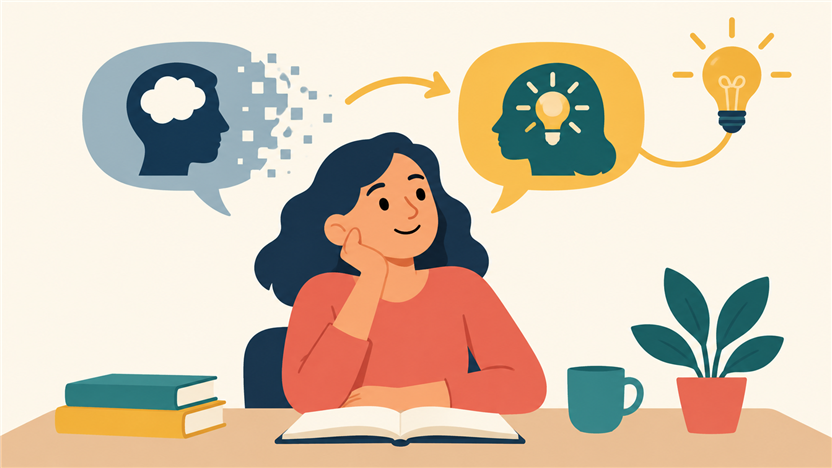
Vocabulary forgetting is not a personal failure. Memory weakens when information is not retrieved, connected, or used. The answer is not to collect bigger lists. It is to create stronger memories and practice pulling words out when you need them.
English speakers receive a useful advantage: Spanish and English share many related words. Información, posible, importante, and decisión are wonderfully accessible. But similarity can also mislead. Embarazada does not mean embarrassed, and actualmente usually means currently. A fast vocabulary system must exploit real connections without blindly trusting appearances.
Learn fewer words more deeply
Ten usable words beat fifty familiar-looking words. A word becomes usable when you know:
- Its core meaning
- How it sounds
- What words commonly surround it
- One or two grammatical patterns
- A personal context in which you might say it
Instead of learning cuenta as a translation, meet it in useful phrases:
- la cuenta, por favor — the bill, please
- una cuenta bancaria — a bank account
- darse cuenta de — to realize
- tener en cuenta — to take into account
Words live in networks. Learn the network you are likely to use.
Prioritize frequency and relevance
High-frequency verbs, connectors, and everyday nouns create more communication than rare descriptive vocabulary.
Prioritize language that helps you:
- Express needs: necesitar, querer, poder
- Connect ideas: porque, aunque, entonces, por eso
- Manage conversation: ¿qué significa?, no recuerdo, depende
- Discuss your life: work, family, hobbies, location, routines, plans
- Understand your favorite content
A frequency list can guide you, but personal relevance decides what sticks. A musician needs ensayar; a parent may need recoger a los niños. Learn the Spanish your life keeps asking for.
Use active recall
Rereading a list produces recognition: “Yes, I have seen that.” Conversation requires retrieval: “Can I produce it now?”
Hide the answer and attempt it. Use a picture as the prompt. Complete a sentence. Answer a question. Describe a definition in Spanish.
If the card asks “to realize,” the answer should not stop at darse cuenta. Say a sentence: Me di cuenta de que había perdido las llaves. The extra effort makes future recall easier.
Space your reviews
Review shortly after learning, then allow gradually longer gaps. A typical rhythm might be the same day, the next day, three days later, a week later, and several weeks later.
Spaced-repetition software can schedule this, but paper works too. The important moment is the struggle before the answer returns. If every review is immediate and easy, memory receives little reason to strengthen.
Keep sessions short. Fifty difficult cards at once can turn vocabulary into punishment. Ten to twenty focused minutes is enough for most daily routines.
Create memorable contexts
Abstract words stick when attached to an image, emotion, story, or absurd detail.
For madrugar—to get up very early—picture yourself at 4:30 a.m., holding coffee and complaining: Odio madrugar.
For lograr—to achieve/manage—connect it to a real goal: Quiero lograr una conversación de treinta minutos en español.
Personal examples do not need to be profound. They need to be easy to recall.
Learn word families
One root can unlock several useful forms:
- decidir — to decide
- la decisión — decision
- decidido/a — determined or decided, depending on context
- mejorar — to improve
- la mejora — improvement
- mejor — better
- útil — useful
- utilizar — to use
- la utilidad — usefulness
Notice predictable English-Spanish relationships too: English -tion often corresponds to Spanish -ción, and -ity often relates to -idad. These are patterns, not automatic conversion machines. Confirm actual usage and pronunciation.
Distinguish cognates, false friends, and partial friends
True cognates have similar forms and related meanings: animal, natural, hospital. They can accelerate reading and vocabulary growth.
False friends look familiar but differ in meaning:
- embarazada — pregnant, not embarrassed
- éxito — success, not exit
- asistir — to attend, not usually to assist
- carpeta — folder, not carpet
- constipado — having a cold in Spain, not constipated
Partial friends overlap in some meanings but not all. Realizar can mean to carry out or accomplish; in some contexts it can also mean to realize, but darse cuenta is often the natural choice for “become aware.” Sensible commonly means sensitive, not sensible.
Do not learn a warning without a correct replacement. Store a contrast:
Estoy avergonzado = I am embarrassed.
Está embarazada = She is pregnant.
Verify words through examples
When a Spanish word resembles English, check several reliable example sentences. Ask:
- Does it have the same meaning?
- Is it used in the same situations?
- Does it combine with the same kinds of words?
- Is it formal, regional, or uncommon?
Bilingual dictionaries give a starting point. Monolingual learner dictionaries, well-edited corpora, and examples from trusted sources reveal usage. The first translation in a dictionary is not permission to substitute the word everywhere.
Turn input into a vocabulary loop
Use a simple cycle:
- Read or listen for meaning.
- Select no more than five high-value items.
- Save each item with its original sentence.
- Create one personal sentence.
- Retrieve the items over several days.
- Use at least two in speech or writing that week.
This connects comprehension with production. It also prevents your flashcard deck from filling with words you encountered once and will never need.
Practice circumlocution
Vocabulary growth will never eliminate every gap. Fluent communication depends on explaining around missing words.
If you forget sacacorchos—corkscrew—say:
Es una cosa que se usa para abrir una botella de vino.
Practice with random objects. Describe category, appearance, location, purpose, and contrast:
Es un animal pequeño. Vive en… Tiene… Se parece a…
Circumlocution reduces panic and creates opportunities for the other person to supply the word.
Keep a “words I needed” list
After a conversation or writing task, note the words you wanted but could not produce. These gaps are highly relevant. Choose three, verify them, and build examples.
This list is often more valuable than a generic list because it comes directly from your communicative life. Review it before the next conversation.
A fifteen-minute daily vocabulary routine
Five minutes: Retrieve older phrases without looking.
Five minutes: Learn three new items from meaningful input.
Three minutes: Create personal examples aloud.
Two minutes: Tell a tiny story using at least one old and one new item.
Once a week, remove weak or irrelevant cards, review recurring false friends, and record a short monologue using the week’s vocabulary.
Build vocabulary that moves
A large passive vocabulary is useful, but your immediate goal is language that can move into a sentence. Select fewer items. Learn chunks and families. Retrieve them after a delay. Meet them again in input. Use them in your own stories.
Treat familiar-looking words as opportunities that require verification, not traps to fear. Cognates can accelerate learning dramatically when you respect differences in meaning and usage.
You will still forget words. Everyone does. The measure of progress is how often useful language returns when the conversation needs it—and how skillfully you keep communicating when it does not.