
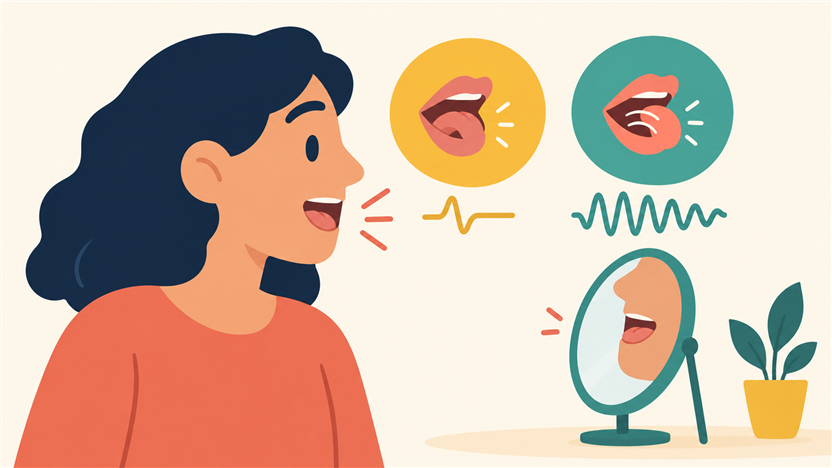
Few Spanish sounds attract as much attention as the rolled rr. Learners celebrate it, fear it, and sometimes practice until their jaw hurts. Meanwhile, the shorter tap in pero quietly causes just as many misunderstandings.
Spanish commonly distinguishes two rhotic sounds: a quick tap and a stronger trill. They can change meaning: pero means “but,” while perro means “dog.” Research on Spanish rhotics shows that these sounds are articulatorily complex and develop gradually, even in some bilingual and native-speaking children. Difficulty does not mean your mouth is defective.
The goal is clear, comfortable speech—not a theatrical roll. Start with the tap, build the tongue position, and approach the trill without forcing it.
Understand the two sounds
The tap is a single, very quick contact of the tongue near the ridge just behind the upper front teeth. You hear it in:
- pero
- cara
- arena
- para
The trill uses repeated contacts created by airflow:
- perro
- carro
- arriba
- rojo
At the beginning of a word, written r normally represents the stronger sound: ropa, rápido. After n, l, or s, it is also typically strong: Enrique, alrededor, Israel.
Find the tap through an English sound
In many North American English accents, the middle sound in “water,” “butter,” or “city” is a quick tap. It is not identical in every speaker, but it can help you locate the movement.
Say “butter” naturally and notice the tongue’s brief contact. Then practice Spanish sequences:
ara, ere, iri, oro, uru
Move to words: cara, pero, mira, ahora. Keep the tongue relaxed. The tap is fast; holding tension makes it harder.
Place the tongue correctly
Touch the ridge behind your upper teeth with the tip of your tongue. Do not curl it far backward. Let the sides of the tongue make light contact with the upper side teeth so air moves along the center.
For the trill, the tongue tip should be close enough for the airflow to move it, not pressed firmly against the ridge. The tongue does not repeatedly “strike” by conscious muscle effort. Air sets a relaxed tip into vibration.
If you squeeze harder, you usually stop the vibration.
Separate airflow from voice
Before adding a vowel, practice a steady stream of air with the tongue near the target position. Avoid puffing your cheeks or pushing from the throat.
Some learners find combinations with t or d helpful because those consonants place the tongue near the right area:
tra, tre, tri, tro, tru
dra, dre, dri, dro, dru
Say them lightly and rhythmically. Do not turn practice into a battle. Ten relaxed attempts across the day are better than ten painful minutes in one session.
Build from supportive contexts
The trill may appear more easily next to certain vowels or consonants. Experiment with:
- pr, br, tr, dr, cr, gr
- arra, erre, irri, orro, urru
- words such as tres, brazo, grande, alrededor
If a context works, use it as a bridge. Gradually remove the supporting sound or move the trill into new words.
Do not assume everyone will unlock the trill with the same exercise. Mouth anatomy, tension, existing accent, and motor habits differ.
Practice the meaningful contrast
Once you can produce a tap and some form of stronger r, use minimal pairs:
- pero / perro
- caro / carro
- coro / corro
- para / parra
Record both words inside sentences:
El coche es caro.
El carro está aquí.
The difference need not sound dramatic. It needs to be clear enough for listeners to identify the intended word.
Protect the Spanish vowels
An English accent in Spanish is not caused only by r. English speakers often reduce unstressed vowels or turn single vowels into gliding diphthongs. Spanish vowels are generally shorter and steadier.
Practice a, e, i, o, u without changing mouth position midway. Compare English “day,” which often glides, with Spanish de. A clean vowel before and after the tap can improve the whole word even before your r is perfect.
Try rhythmic sequences:
para, pera, pira, poro, puro
Keep each vowel distinct and the tap brief.
Copy rhythm and stress
Pronunciation is larger than individual sounds. Spanish timing, stress, linking, and intonation strongly affect comprehensibility.
Choose a sentence containing your target sound:
Quiero comprar un regalo para Rosa.
Listen several times. Mark the strongest syllables. Clap the rhythm, then shadow the recording. Record yourself and compare the entire phrase—not only the r.
A slightly imperfect trill inside good rhythm is often easier to understand than a perfect trill inside heavily English timing.
Avoid the common mistakes
Do not use a prolonged English R. The English approximant keeps the tongue from touching the ridge; Spanish taps and trills require a different gesture.
Do not tense the jaw. The tongue needs freedom to move.
Do not practice only isolated noise. Transfer the sound into syllables, words, and sentences immediately.
Do not judge by vibration alone. Record meaningful words and ask whether the contrast is intelligible.
Do not practice through pain. Stop, relax, and return later.
Use feedback intelligently
A teacher, speech coach, or skilled native speaker can identify whether the problem is placement, airflow, tension, or timing. Ask a specific question: “Does pero sound different from perro?” This produces more useful feedback than “How is my accent?”
Speech-recognition tools can provide extra practice, but they are not perfect judges. Treat them as one source of feedback, not a final authority.
A ten-minute daily routine
Two minutes: Relax the jaw and practice clean Spanish vowels.
Two minutes: Produce quick taps in vowel sequences and easy words.
Two minutes: Try relaxed trill-support combinations such as tra and dra.
Two minutes: Practice two minimal pairs inside sentences.
Two minutes: Shadow one natural sentence and record it.
Review the recording once. Choose one adjustment for tomorrow. Then stop.
Make intelligibility the goal
Some learners acquire a trill quickly. Others need months, and a few communicate beautifully with a sound that never becomes a textbook trill. Accent is not a measure of intelligence, effort, or respect.
Prioritize distinctions that affect understanding. Master the tap, develop a recognizably stronger sound where Spanish needs it, keep vowels clear, and copy natural rhythm. Your pronunciation will improve through short, attentive practice and real communication—not through shame or brute force.